

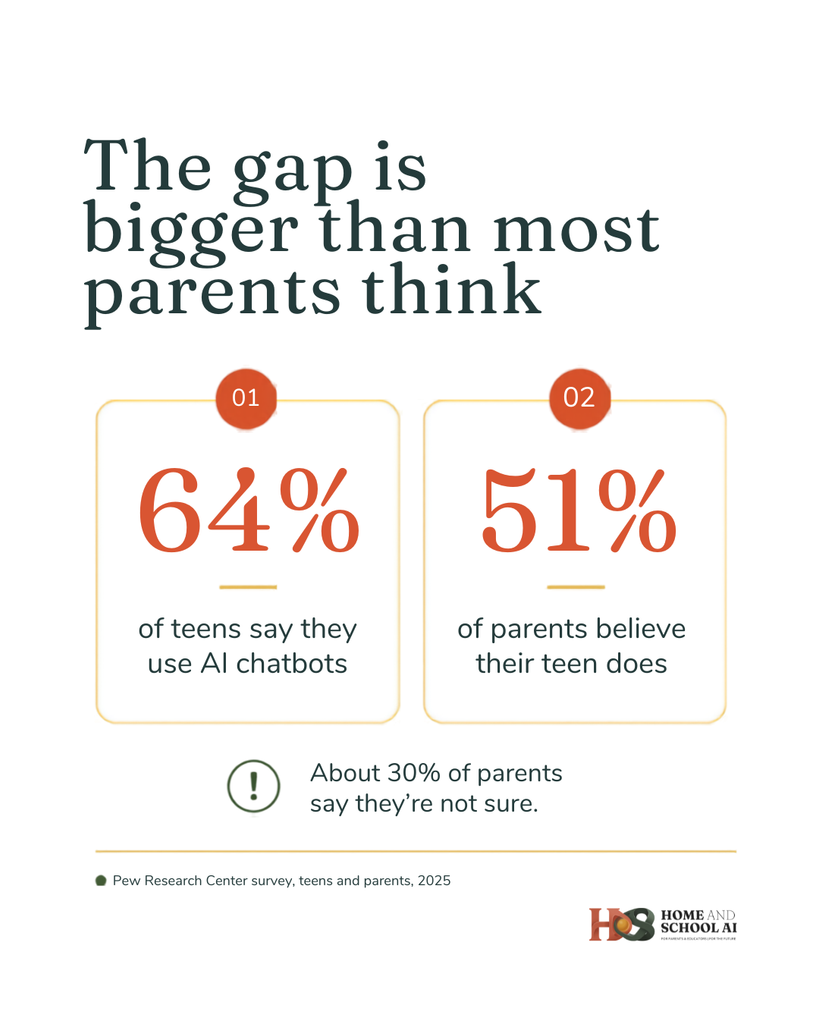
Here’s a number worth sitting with before anything else in this piece: in a Pew Research Center survey that questioned teens and their own parents side by side, 64% of teens said they use AI chatbots, but only 51% of their parents believed their teen used them, and roughly 30% of parents said they simply weren’t sure. That’s not a small gap. That’s a coin flip’s worth of parents who have no idea what’s actually happening.
We’ve seen versions of this gap before, with social media a decade ago and with smartphones before that. The pattern tends to repeat: a new technology moves faster into kids’ daily lives than it moves into parents’ awareness of that daily life, and by the time the awareness catches up, the habits are already formed. AI chatbots appear to be following the same curve, just faster, since there’s no app icon to notice on a home screen the way there would be for a new social platform. A chatbot conversation can happen inside a messaging app, a search bar, or a homework tool your kid already had permission to use.
The instinct that follows a stat like that is usually “I need to see everything.” We’d push back gently on that instinct, not because visibility doesn’t matter, but because how you get it matters just as much as whether you get it.
What Parents in the Same Survey Said They’re Okay With
The same research found parents aren’t uniformly opposed to AI use; they’re specific about which uses concern them. Roughly 80% of parents were fine with their teen using a chatbot to search for information. About 60% were okay with it for schoolwork. Only 18% approved of using AI for emotional support.
That last number is the one worth paying attention to, because it’s also the use case parents are least likely to know is happening. Kids don’t usually announce “I’ve been talking to ChatGPT about how I’m feeling.” It shows up quietly, in a habit that looks like scrolling or texting from across the room.
Why “Just Check Their Phone” Isn’t the Whole Answer
Reading a teenager’s private messages without them knowing, and without a conversation about why, tends to produce one of two outcomes: they find out and stop trusting you with anything, or they learn to have the conversations you’re worried about somewhere you can’t see at all. Neither outcome gets you what you actually want, which is a kid who comes to you when something feels off.
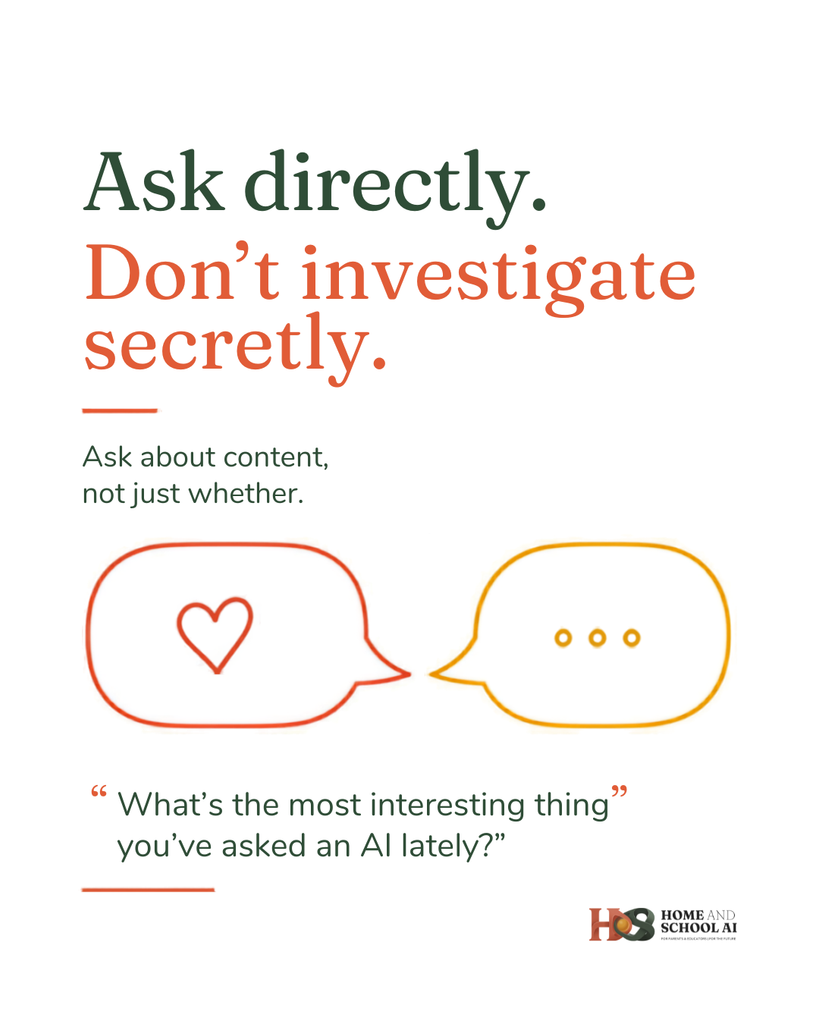
That doesn’t mean hands-off is the answer either. Experts in adolescent psychology, in guidance compiled by PolitiFact from six specialists, generally converge on the same starting point: ask directly, rather than check secretly. “The best way to know if your child is using AI chatbots is simply to ask, directly and without judgment,” as one bioethics professor put it in that reporting. It sounds almost too simple to be advice, and it works better than most parents expect, mostly because most kids have never been asked.
A Way to Check That Doesn’t Feel Like Surveillance
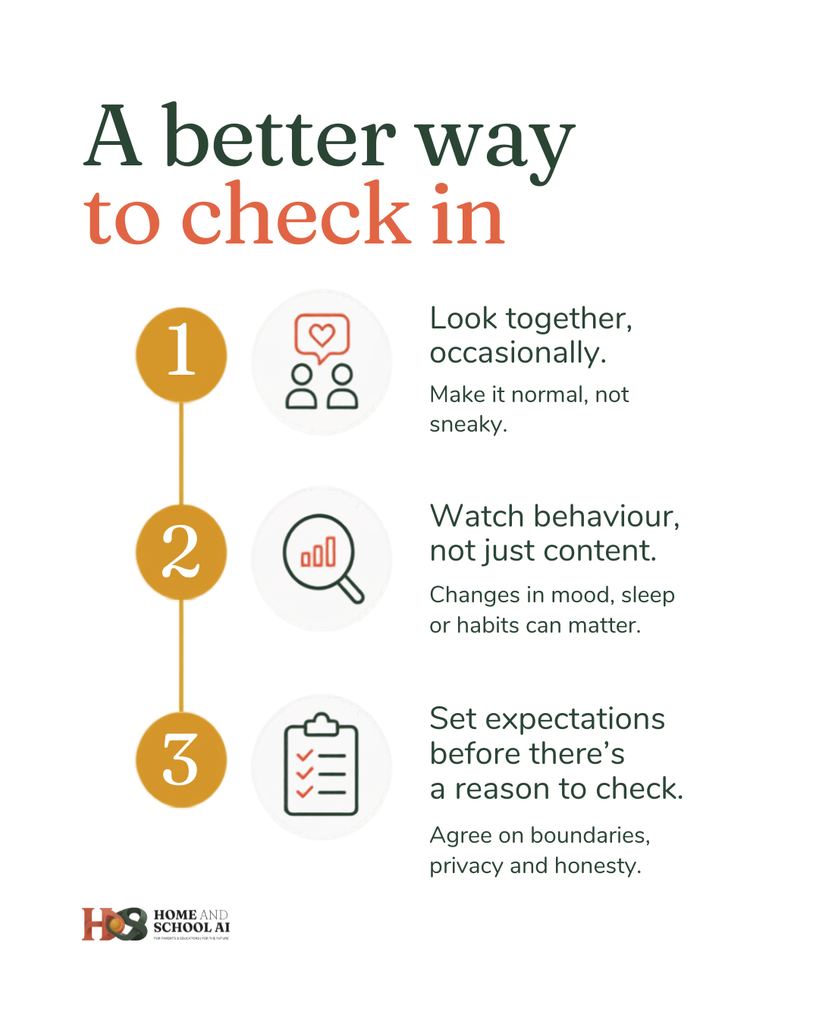
Ask about content, not just whether. “Have you ever used an AI chatbot?” gets a yes-or-no answer that tells you nothing. “What’s the most interesting thing you’ve asked an AI lately?” invites an actual answer, and it usually surfaces more than a direct interrogation would.
Look together, occasionally, rather than checking alone. For a younger kid especially, “show me something you asked it today” as a casual, regular habit does more than one long, thorough read through months of chat history. It normalizes the idea that this is something you look at together, not something you catch them doing.
Watch behavior, not just content. The clearest warning sign isn’t a specific chat log. It’s a pattern: withdrawing from friends, family, or activities they used to enjoy, in favor of time spent talking to a chatbot. That behavioral shift matters more than any individual conversation you might find, and it’s visible without reading a single message.
Set the expectation up front, before there’s a reason to check. “I’m going to ask about this sometimes, the same way I ask about your other friendships,” said early and calmly, lands very differently than a surprise check after the fact.
When to Go Further Than a Conversation
We want to be direct about something most parenting content glosses over. Some conversations teens have with AI chatbots touch on real emotional distress, including thoughts of self-harm, and there have been tragic, well-documented cases of this going badly. If your instincts are telling you something is more serious than a normal use pattern, a private, secretive relationship with a chatbot, withdrawal from people who care about them, signs of real distress, that’s the moment to involve a mental health professional directly, not just adjust a house rule.
If you or your teen are in crisis right now, the 988 Suicide & Crisis Lifeline is available by call or text, any time, and it’s a resource worth having saved in your phone before you need it, not after.
What This Isn’t About
To be clear, most AI chatbot use by most kids is genuinely mundane: homework help, curiosity, the digital equivalent of asking a smart older sibling a question. The goal of checking in isn’t to treat every chatbot conversation as a red flag. It’s to know the difference between the ordinary use that makes up the vast majority of it, and the smaller slice that deserves a closer look.
There’s a version of this that can tip into overcorrection, and it’s worth naming: a parent who checks in so frequently, or so anxiously, that the kid starts hiding ordinary, harmless use out of sheer exhaustion with the questions. If your kid mentions using AI for something completely unremarkable and gets an intense reaction from you anyway, they learn to stop mentioning it at all, which is the opposite of what any of this is trying to build. Calibrate the intensity of your response to what you’re actually finding, not to your general anxiety about the technology.
A Few Questions Parents Ask Us
My teenager says checking in on this feels like I don’t trust them. How do I respond?
Separate trust in your kid from trust in a fairly new, unregulated technology. “I trust you completely. I don’t trust a chatbot company’s product roadmap, and I want to make sure you don’t have to navigate that alone” is a distinction most teens can accept, especially if you’ve applied the same logic to social media or other apps before.
What if I find something concerning? Do I confront them immediately?
Take a beat first. Lead with curiosity rather than accusation: “I saw this, can you help me understand what was going on” tends to get you further than “why would you say that to a robot.” How you open the conversation determines whether it continues.
Are there tools that monitor this automatically, so I don’t have to check manually?
Some parental control software has started adding AI chat monitoring, and it can be a useful backstop, particularly for younger kids. It shouldn’t replace the direct conversation above, though; a kid who only experiences monitoring as surveillance, without ever being asked directly, tends to route around it eventually.
Related Reading
- AI for Parents: The Two AI Risks Nobody Warned You About Yet
- Parenting with AI: The Household Rules That Actually Stick
Where to Go Deeper
The specific risks worth watching for, AI companions your kid may have formed an attachment to, and what to do if a conversation crosses a line, are covered in full in AI Safety for Kids: The Two Risks Nobody Warned You About, and Exactly What to Do About Each, a field guide for parents and educators to AI companions, AI-generated fake images, and what to do the day either one shows up. You can explore it at homeandschoolai.com.
Sources
- Pew Research Center survey of U.S. teens and parents, conducted September to October 2025, as reported by Let’s Data Science: https://letsdatascience.com/news/parents-report-teens-using-ai-chatbots-95b762b9
- PolitiFact, “AI Chatbots, Companions Talk to Kids: A Parent’s Guide,” December 2025: https://www.politifact.com/article/2025/dec/19/AI-chatbots-companions-talk-to-kids-parent-guide