

Sooner or later, you’re going to sit across from a parent who is genuinely certain their kid wouldn’t do the thing you’re describing. It might be about an essay that reads like it wasn’t written by the student who submitted it. It might, in a smaller number of cases, be about something more serious involving AI. Either way, the parent across the table is likely to start from a place of confidence that doesn’t match what the research says confidence like that is usually worth.
The Confidence Gap, in Two Different Contexts
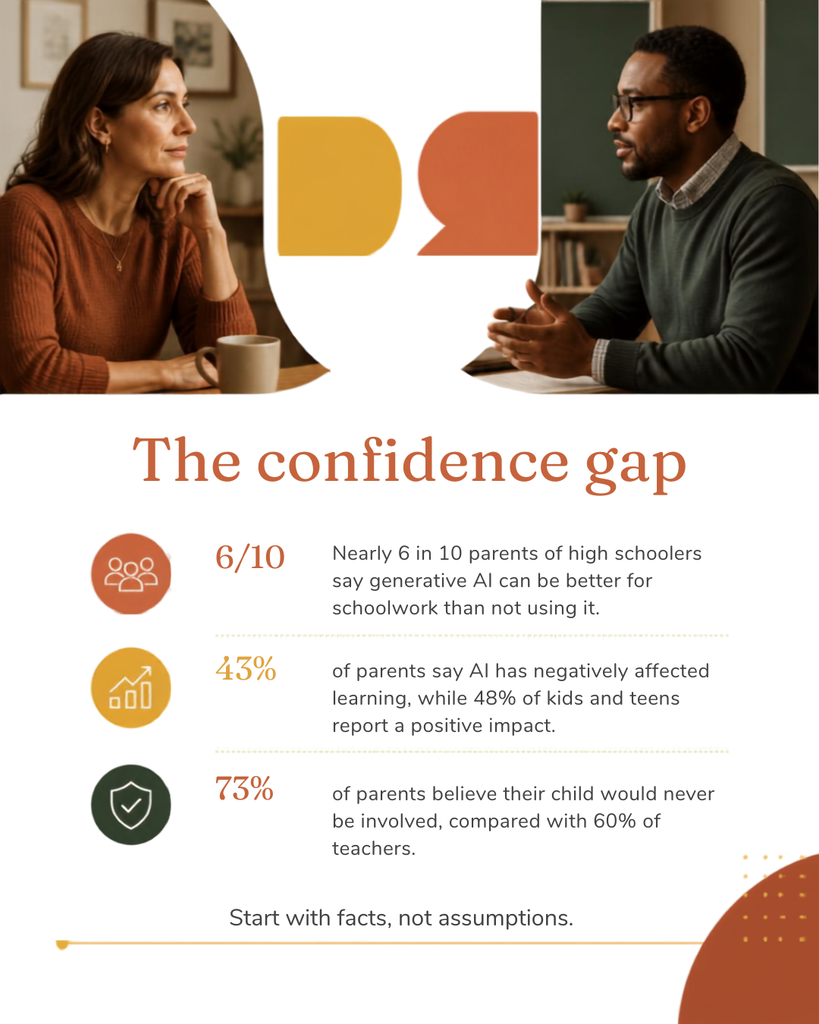
On academic honesty specifically, nearly 6 in 10 parents of high schoolers say it’s better for students to use generative AI for schoolwork than not to, according to College Board research published in 2025, a number that shows most parents have already made peace with AI as part of normal schoolwork, which is exactly why a conversation about misuse can catch them off guard. A separate Common Sense Media survey found 43% of parents believe AI has had a negative impact on their kids’ learning at school, while a notably higher 48% of kids and teens themselves reported a positive impact, a real perception gap that’s worth knowing walks into the room with you.
On the more serious end, one study found that 73% of parents believe their own child would never be involved in an AI-generated harm incident, whether as a target or as someone responsible for creating or sharing something harmful, compared with only 60% of teachers who believe the same about their own students. You are, statistically, more likely to be right about the risk than the parent sitting across from you, which is an uncomfortable position to be in and also exactly why the conversation needs to happen carefully.
Script One: The Academic Integrity Conversation
This is the far more common version. A parent’s first reaction is often defensive, not because they’re unreasonable, but because “your kid may have used AI dishonestly” can land as an attack on their parenting, not just a comment about an assignment.
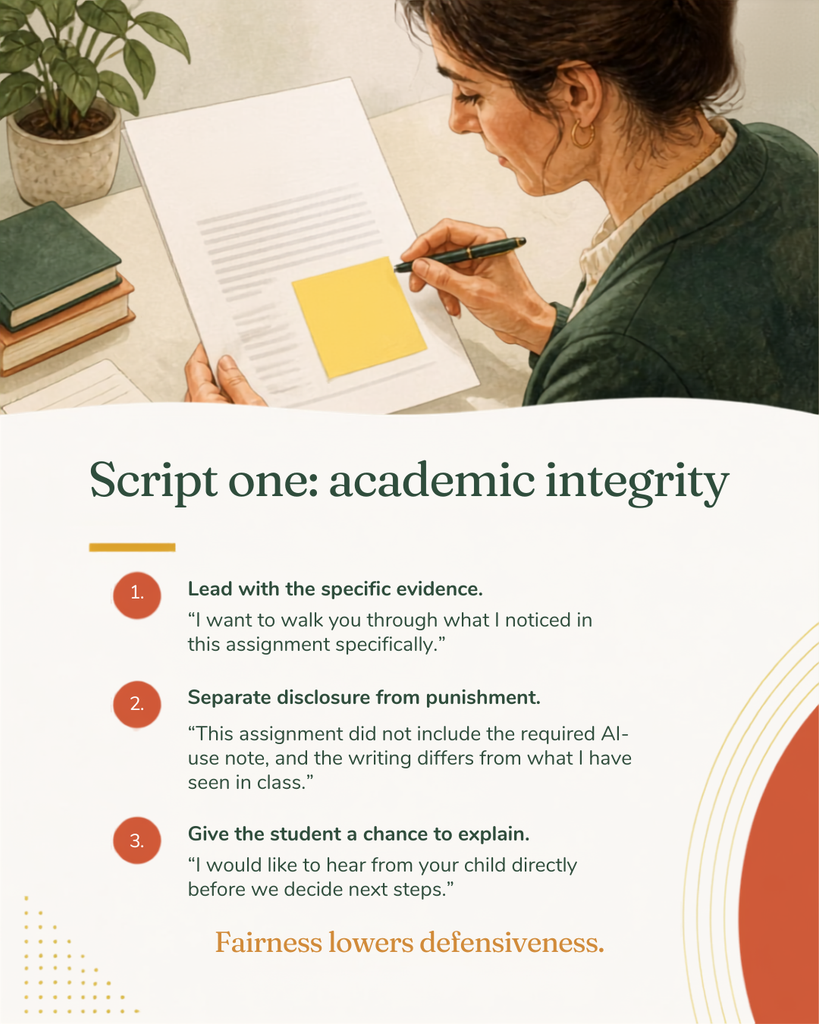
Open with the specific evidence, not a general accusation.
“I want to walk you through what I noticed in this assignment specifically” works better than “I think your child used AI to cheat.” The first invites a conversation about facts. The second invites a defense of character.
Separate the disclosure question from the punishment question.
“My policy asks students to note when they’ve used AI. This assignment didn’t include that note, and the writing doesn’t match what I’ve seen from your child in class” describes a process failure, which is easier for a parent to hear and address than a moral one.
Give the student a way to explain before concluding anything.
“I’d like to hear from your child directly about how this was written before we decide next steps” signals fairness, which tends to lower defensiveness faster than any other single thing you can say.
Acknowledge the genuine gray area.
Given that 68% of colleges and a similar share of high schools have no clear written policy on AI use, most parents have some accurate sense that the rules here are still being worked out. Naming that directly, “I know this is a confusing area right now, and I want to be clear about where I stand as your child’s teacher,” tends to defuse some of the parent’s instinct to fight the premise of the conversation itself.
Script Two: The Safety Conversation
This conversation is rarer, more serious, and requires more care. It applies when what you’re discussing isn’t academic dishonesty but something closer to the risks covered in our companion piece on AI companions and AI-generated fake images: a student’s AI companion use has become a concern, or, in the more severe cases, an AI-generated image involving a student.
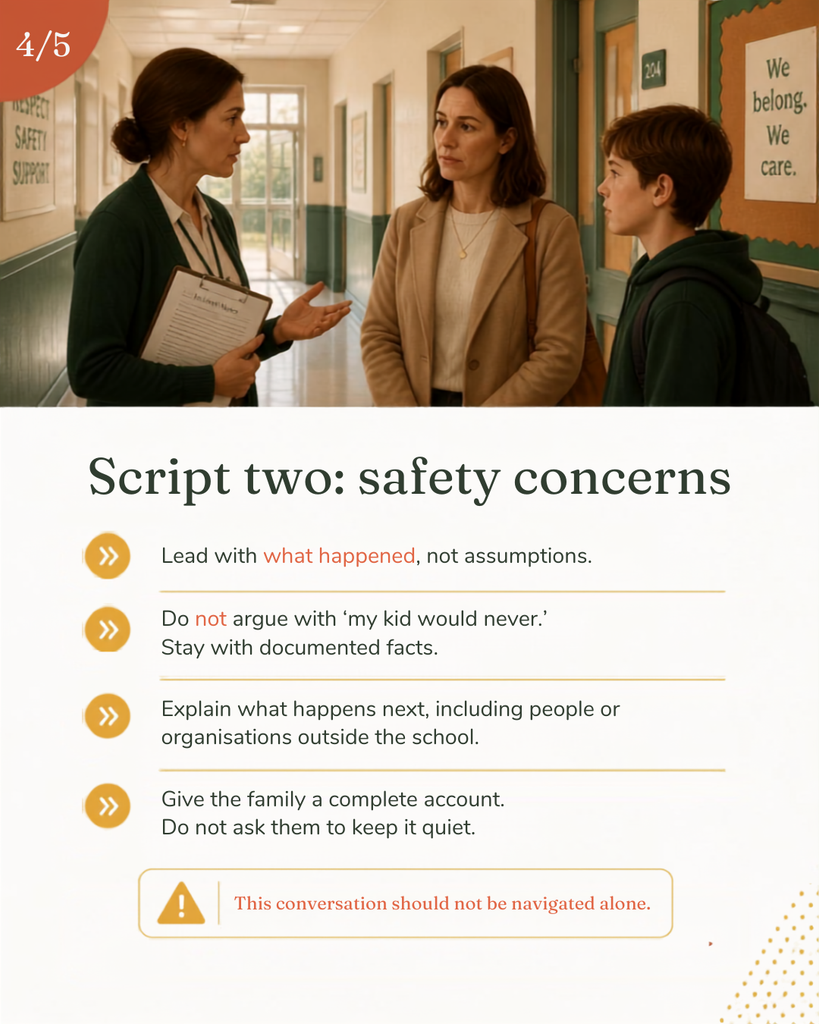
Lead with what happened, not with the parent’s assumptions about their kid.
Whether their child is the one affected or the one responsible, starting with concrete facts rather than character judgments keeps the conversation productive. “Here’s what we know happened” is a stronger opening than anything framed around what kind of kid would or wouldn’t do this.
Expect the 73% reaction, and don’t argue against it directly.
A parent’s instinct that “my kid wouldn’t” is common and, per the research, not a reliable predictor either way. Arguing directly against that instinct tends to entrench it. Sticking to documented facts, rather than trying to convince a parent their assumption about their own child is wrong in general, moves the conversation forward faster.
Be explicit about what happens next, including anything outside your control.
If law enforcement, a Title IX coordinator, or the National Center for Missing & Exploited Children’s CyberTipline is involved, say so plainly and early. Parents deserve to know the full scope of what’s happening, not a version that gets revealed in pieces over several conversations.
Don’t ask the family to keep it quiet.
Some documented cases nationally have involved schools requesting that affected families not discuss an incident publicly, which tends to erode trust rather than contain a situation. Give families an honest, complete account and let them decide how to handle it from there.
What Both Scripts Have in Common
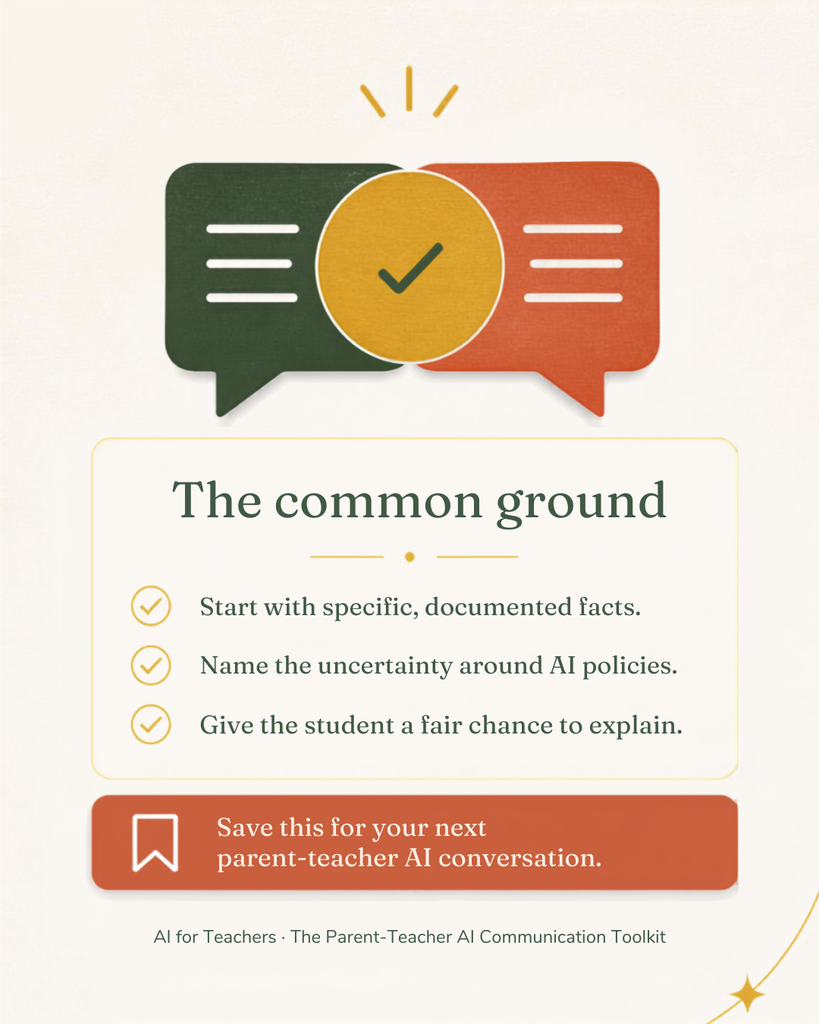
Neither conversation goes well if it starts from an assumption about the kid’s character, good or bad. Both go better when they start from specific, documented facts, and both benefit from acknowledging, out loud, that most parents walk in more confident than the data suggests they should be, in either direction. That’s not a criticism of parents. It’s just a pattern worth naming before it works against the conversation you’re trying to have.
A Few Questions Teachers Ask Us
What if the parent gets angry regardless of how carefully I open the conversation?
That will happen sometimes no matter what you say, and it’s worth preparing for rather than treating as a sign you did something wrong. Stay with the facts, involve administration if the conversation escalates, and don’t take responsibility for a reaction you can’t fully control.
Should I loop in administration before having either conversation, or only after?
For the academic integrity script, your judgment as the classroom teacher usually suffices to start, with administration looped in if it escalates. For the safety script, involve administration and your Title IX coordinator before the parent conversation happens, not after; that conversation shouldn’t be one you’re navigating alone.
How do I handle a parent who brings up that “everyone uses AI now” as a defense?
Agree with the part that’s true, most students do use AI in some form, and most schools haven’t caught up with clear rules yet, then redirect to the specific issue at hand. “You’re right that this is common, and that’s exactly why I want to be clear and fair about what happened in this specific case” keeps the conversation from getting lost in a broader debate you don’t need to win.
Related Reading
- AI for Teachers: What to Do the Day a Deepfake Shows Up at Your School
- AI for Parents: The Two AI Risks Nobody Warned You About Yet
For the Harder Version of This Conversation
When the conversation moves beyond academic honesty into AI companions or AI-generated fake images, having the fuller picture matters, both for how you talk to the family and for what you recommend they do next at home. AI Safety for Kids: The Two Risks Nobody Warned You About, and Exactly What to Do About Each is a field guide for parents and educators to AI companions, AI-generated fake images, and what to do the day either one shows up. You can explore it at homeandschoolai.com.
Sources
- College Board, “New Research: Majority of High School Students Use Generative AI for Schoolwork,” October 2025: https://newsroom.collegeboard.org/new-research-majority-high-school-students-use-generative-ai-schoolwork
- Common Sense Media / Statista, “Parents and Youth on AI Impact on School Learning,” January 2025: https://www.statista.com/statistics/1613455/parents-and-youth-on-ai-impact-on-school-learning
- The Human Factor study, reported via The Decoder, “Deepfake Nudes: Parents Clueless, Teachers Suspicious, Students Split”: https://the-decoder.com/deepfake-nudes-parents-clueless-teachers-suspicious-students-split/
- Kaplan, “College Admissions Officers Survey 2025: Essays & AI,” November 2025: https://kaplan.com/about/press-media/college-admissions-officers-survey-2025-essays-ai