
A Stanford study tested seven popular AI detection tools on 91 TOEFL essays, every single one written entirely by a human, specifically non-native English speakers. The detectors flagged 61% of those essays as AI-generated. None of them were. The same tools performed near-perfectly on essays written by U.S.-born eighth graders, which tells you the false positives weren’t random noise; they were concentrated on exactly the students least equipped to defend themselves against the accusation.
That bias pattern shows up in real classrooms, not just in a controlled study. A junior at a Virginia high school had her college application essay, about her grandmother’s immigration story, flagged as3 92% AI-generated by a detection tool. She’d written every word herself; her grandmother had helped her recall details of the family’s journey. It took a two-month appeals process to clear her name, well past the point where the accusation had already cost her trust, stress, and time she needed for the rest of her applications. Stories like this one aren’t rare exceptions to how detection tools perform. They’re a predictable consequence of how the tools work.
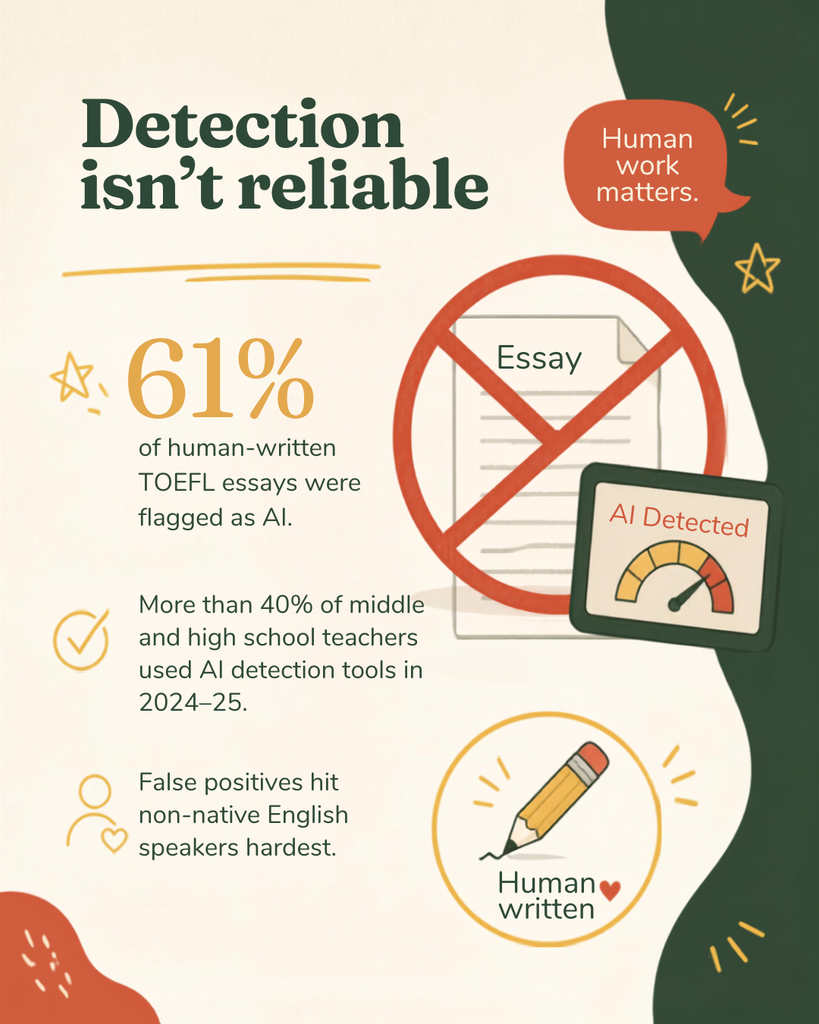
More than 40% of 6th through 12th grade teachers used AI detection tools during the 2024-2025 school year, according to a Center for Democracy & Technology survey. At least a dozen universities, including Yale, Johns Hopkins, and Northwestern, have disabled Turnitin’s AI detection feature entirely, citing exactly this kind of unreliability. If institutions with far more resources than a single classroom have concluded detection isn’t trustworthy enough to rely on, that’s worth taking seriously before building a policy around catching students after the fact.
The better move, and the one this piece is actually about, is designing assignments where the question of “did AI write this” mostly stops mattering.
Why Redesign Beats Detection
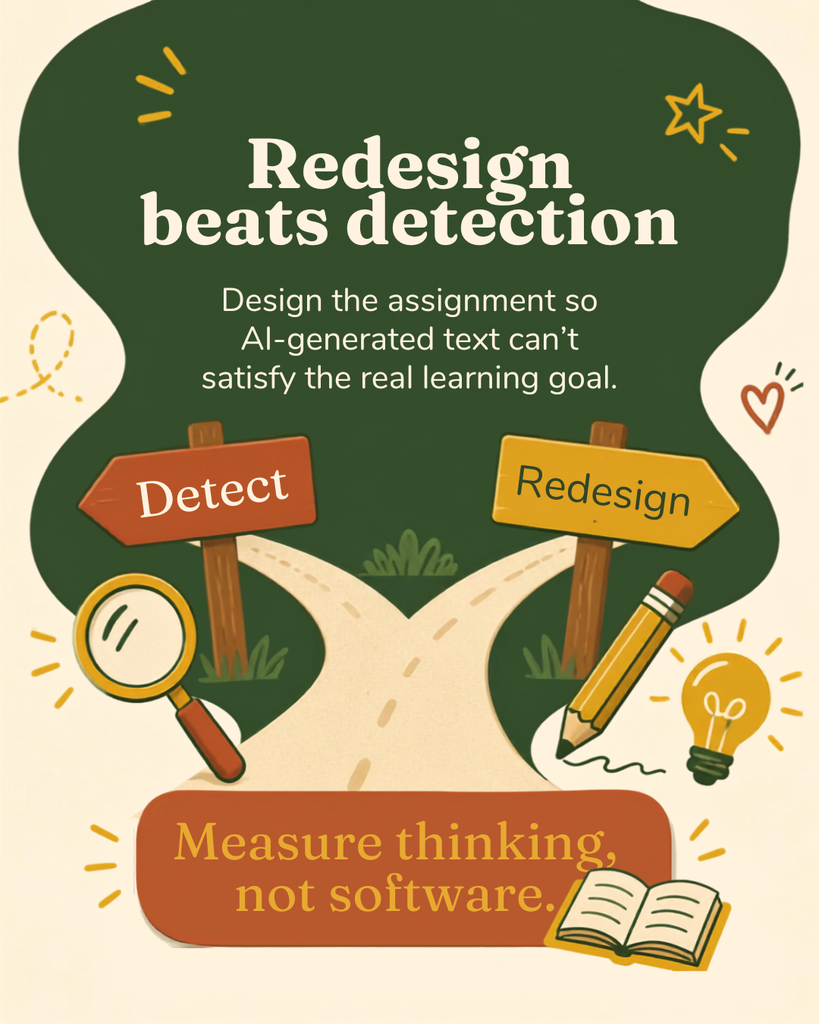
Detection is a bet that you can identify AI use after a student turns something in. Redesign is a bet that you can make an assignment where AI-generated text doesn’t actually satisfy what you’re asking for, whether or not a student used it. The second bet doesn’t depend on unreliable software, doesn’t put you in the position of accusing a student based on a tool with a documented bias problem, and doesn’t require you to stay one step ahead of whatever the newest model can produce.
It also solves a problem detection never will: even a perfectly accurate detector only tells you AI was used. It doesn’t tell you whether your assignment was any good at measuring what you actually wanted to measure in the first place. A prompt that a chatbot can answer in one convincing pass was probably never doing a great job of testing original thought, regardless of what technology existed to answer it. Redesign forces a useful, if slightly uncomfortable, question most of us hadn’t had to ask before: would this assignment still be worth assigning if every student in the room had access to a very fast, very confident, occasionally wrong research assistant? For a lot of standard prompts, the honest answer is no, and that’s worth knowing independent of anything AI-related.
Five Ways to Redesign an Assignment
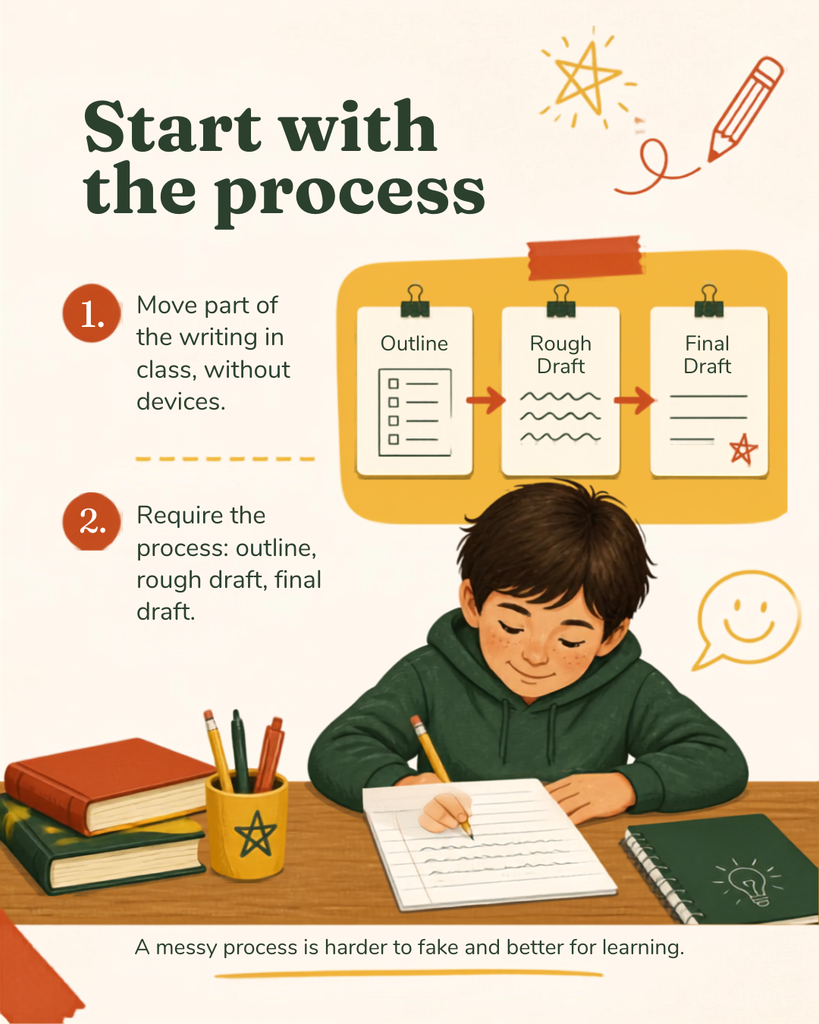
1. Move part of the writing in-class, without devices.
Not the whole essay necessarily, but the thesis, the outline, or a key paragraph, done live, on paper or in a supervised setting. A student who can produce a coherent version in class has demonstrated something a take-home essay alone can’t confirm.
2. Require process, not just product.
Ask for an outline, a rough draft, and a final draft, each submitted separately and dated. A student who used AI to generate a finished essay in one shot will struggle to fabricate a plausible, messy earlier draft to go with it. This also happens to be good pedagogy independent of the AI question; process-based writing instruction has always produced stronger writers than single-draft assignments.
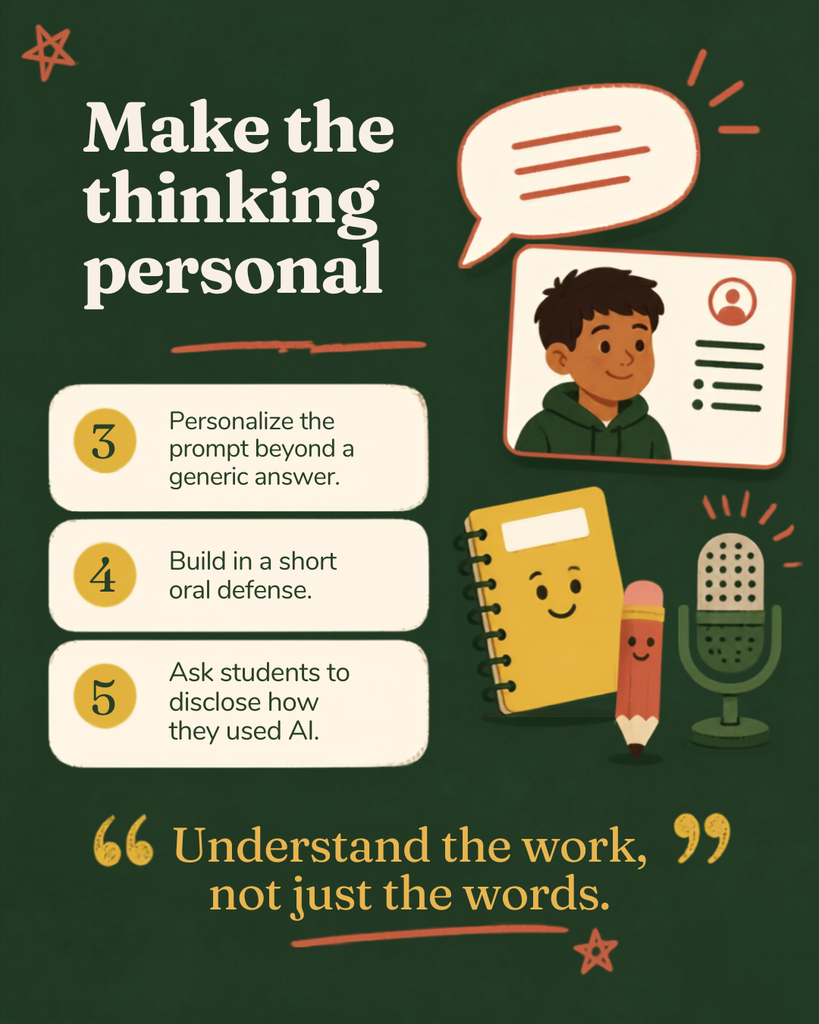
3. Personalize the prompt beyond what a generic answer can satisfy.
“Analyze the causes of the French Revolution” produces a generic, AI-friendly answer. “Connect one cause of the French Revolution to a decision you’ve seen made in your own life, at school, in a family, in a group project, and explain the parallel” requires specific, personal content no chatbot can generate on a student’s behalf.
4. Build in a short oral defense.
A five-minute conversation where a student explains their own argument, in their own words, without notes, is one of the hardest things to fake regardless of who or what wrote the original draft. This doesn’t need to happen for every assignment; reserving it for major papers keeps the workload manageable while still restoring the incentive to actually understand the material.
5. Make the disclosure question part of the assignment itself, not an afterthought.
Instead of policing use after submission, build a required reflection into the assignment: “describe any AI tools you used and how.” This does two things at once. It gathers the information you’d otherwise be guessing at through detection software, and it normalizes honesty about the tool rather than pushing use underground.
What to Do When You Still Suspect Something
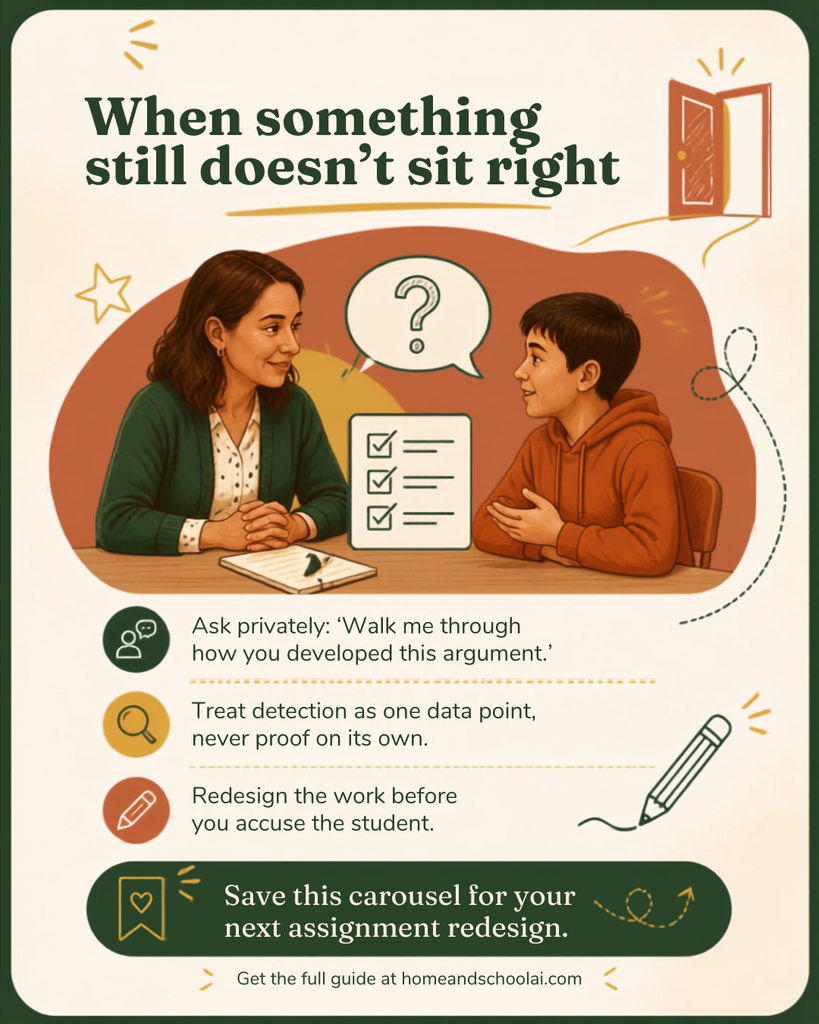
Redesign reduces how often this comes up, but it won’t eliminate every judgment call. When something genuinely doesn’t sit right, a private, non-accusatory conversation gets you further than a detection score ever will: “walk me through how you developed this argument” is a request a student who did the work can answer easily, and one a student who didn’t will struggle with regardless of what any software says. Treat a detection tool’s output, if you use one at all, as a single data point worth a conversation, never as proof on its own.
A Few Questions Teachers Ask Us
Isn’t in-class writing time hard to fit into an already packed curriculum?
It doesn’t need to replace the whole assignment, just one meaningful piece of it, a thesis statement, a key paragraph, an outline. Twenty minutes of class time buys you a genuine data point about whether a student can produce their own thinking, which is worth more than an entire take-home essay you can’t verify at all.
What about students who genuinely benefit from AI as an accommodation, for a learning difference or a language barrier?
This is exactly why redesign works better than a blanket rule. A student using AI to help organize thoughts affected by a processing difference, or to translate a concept they understand in their first language, is doing something categorically different from a student outsourcing the thinking itself. Building in process steps and oral checks lets you support the first case while still catching the second, without needing a separate policy for accommodations.
Do I need to redesign every single assignment this way?
No. Save the heavier redesign, in-class components, oral defenses, for assignments that actually carry weight in a student’s grade or that are meant to demonstrate mastery of something important. Lower-stakes practice work doesn’t need the same level of scrutiny, and treating everything as equally high-risk burns out both you and your students.
Related Reading
- AI for Teachers: A One-Page AI Policy You Can Actually Use Monday Morning
- AI for Teachers: What to Say to a Parent Who’s Sure Their Kid Would Never Cross the Line
What Assignment Redesign Doesn’t Cover
Redesigning assignments solves the academic integrity question. It doesn’t touch a separate, more serious category: AI-generated harm between students, companion attachments that have replaced real relationships, or fake explicit images circulating in your building. Those risks live entirely outside what any classroom policy or assignment structure can catch, and they call for a different kind of preparation. AI Safety for Kids: The Two Risks Nobody Warned You About, and Exactly What to Do About Each is a field guide for parents and educators to AI companions, AI-generated fake images, and what to do the day either one shows up. You can explore it at homeandschoolai.com.
Sources
- Liang et al., published in Patterns (Cell Press, 2023), reported via Fastio, “Best AI Detectors for Teachers: Practical Classroom Tools for 2026”: https://fast.io/resources/ai-detector-for-teachers-2026/
- Center for Democracy & Technology 2025 K-12 AI survey, reported via Fastio (see above)
- Working Educators, “The False Positive Problem Nobody Wants to Talk About,” January 2026: https://workingeducators.org/blog/false-positive-problem