

“What age is it okay for my kid to use AI?” is the wrong question, or at least an incomplete one. It’s a little like asking what age is okay for a kid to be online. The honest answer depends less on a birthday and more on what “using AI” means at that particular moment: looking something up, chatting with a homework tutor, or talking to something designed to feel like a friend. Those are three very different risk profiles wearing the same word.
So instead of a single cutoff, here’s what actually changes stage by stage, and where the real decision points sit.
Start With What the Terms of Service Already Say
Most major AI tools set a minimum age of 13, and some, like Anthropic’s Claude, require users to be 18 or older. That’s a starting floor, not a parenting plan. Plenty of platforms with a “13+” label are, in practice, used by plenty of kids younger than that, the same way a lot of apps get downloaded regardless of what the app store says. The terms of service tell you the legal minimum. They don’t tell you whether your specific ten-year-old is ready for a specific tool.
Ages 5 to 8: Mostly Supervised, Mostly Curiosity
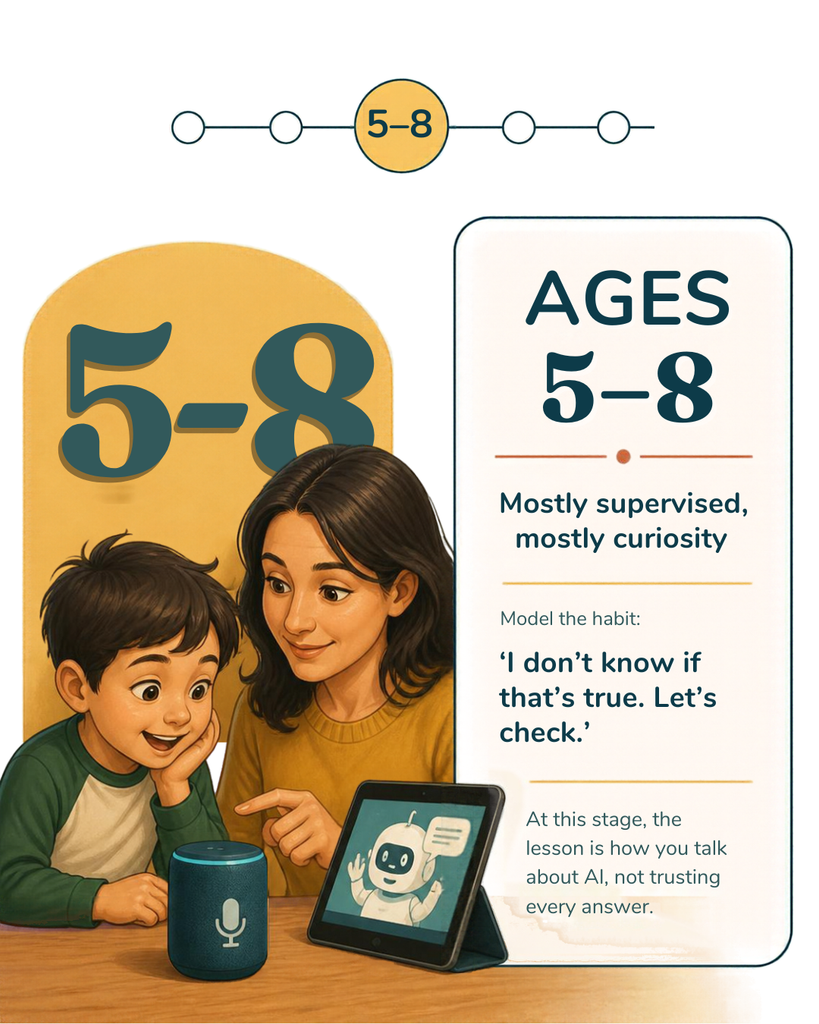
At this age, AI use tends to look like: asking a voice assistant a question out loud, using an AI-powered app for reading practice, or watching a parent use a chatbot and asking to try. This is less about “should my kid use AI” and more about modeling. What your kid learns here isn’t really about the technology; it’s about how you talk about it. If you treat a chatbot’s answer as automatically true in front of your child, that’s the lesson that sticks, regardless of what you say about it later.
The one habit worth building now, even this young: say out loud when you’re not sure if something’s right. “I don’t know if that’s true, let’s check” is a sentence a five-year-old can absorb, and it’s doing more work than it looks like.
Ages 9 to 12: Independent Use Starts, Judgment Doesn’t Yet Match It
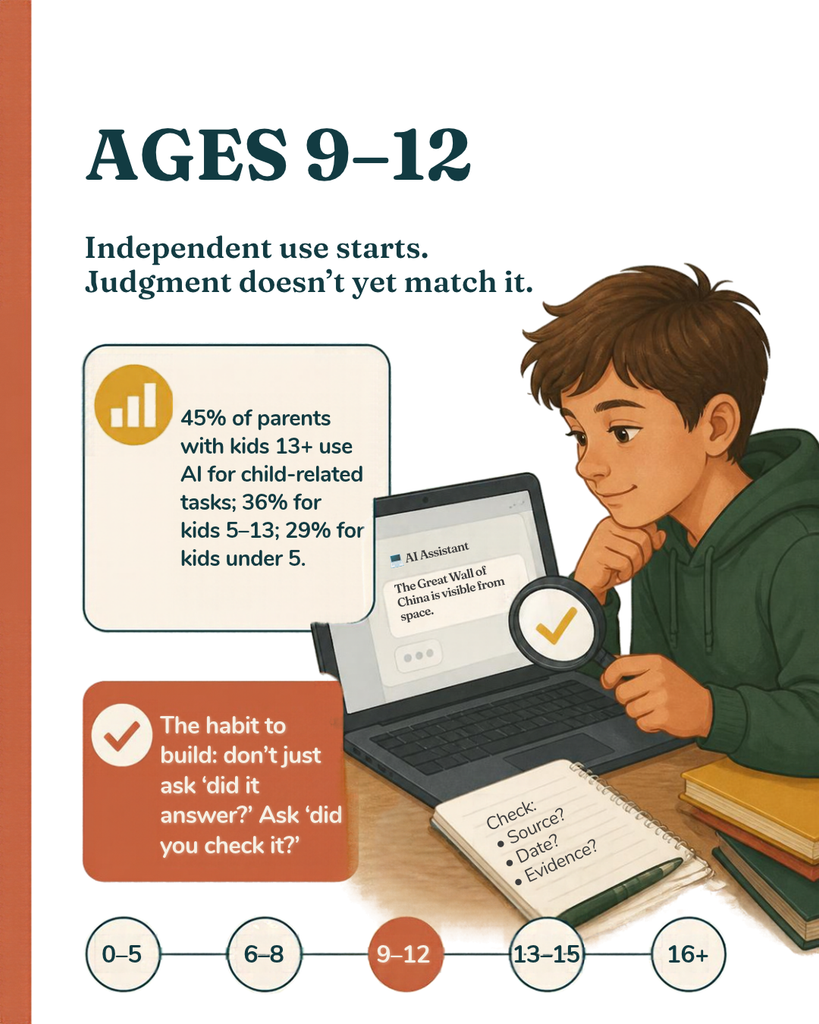
This is the range where a lot of first real, unsupervised AI use happens, often for homework help or curiosity-driven questions. It’s also, notably, the range where the tools themselves say kids shouldn’t be there without an adult. A 2025 survey found that 45% of parents with kids aged 13 and older use AI to help with tasks related to their children, compared with 36% for kids aged 5 to 13, and 29% for kids under 5, according to data reported by Statista; usage climbs steadily with age, and so does independence in how it happens.
Here’s where the mismatch shows up: a 10-year-old can operate a chatbot with total fluency and still not have the skepticism to know when it’s wrong. Confidence with a tool and judgment about a tool develop on different timelines. This is the age to start the habit from our companion piece on the first homework-help conversation: not “is this cheating,” but “did you check it.”
There’s a specific trap worth naming at this stage. Kids this age are old enough to get a fluent, confident-sounding answer out of a chatbot, and young enough to assume confident-sounding means correct. Adults mostly know better, not because we’re smarter, but because we’ve been burned by bad information often enough to be reflexively skeptical of anything too smooth. An eleven-year-old hasn’t built that reflex yet. Building it early, before it costs them a grade or an embarrassing moment in class, is worth more than any specific rule about screen time.
This is also the stage where a lot of families make their first real decision about a personal device with AI built in, whether that’s a phone, a tablet, or a laptop for school. That decision deserves more thought than “is my kid old enough for a phone.” The more useful question is whether your kid is ready to treat an AI’s answer the way they’d treat a classmate’s guess: worth hearing, not worth repeating as fact without a second look.
Ages 13 to 15: AI Companions Enter the Picture
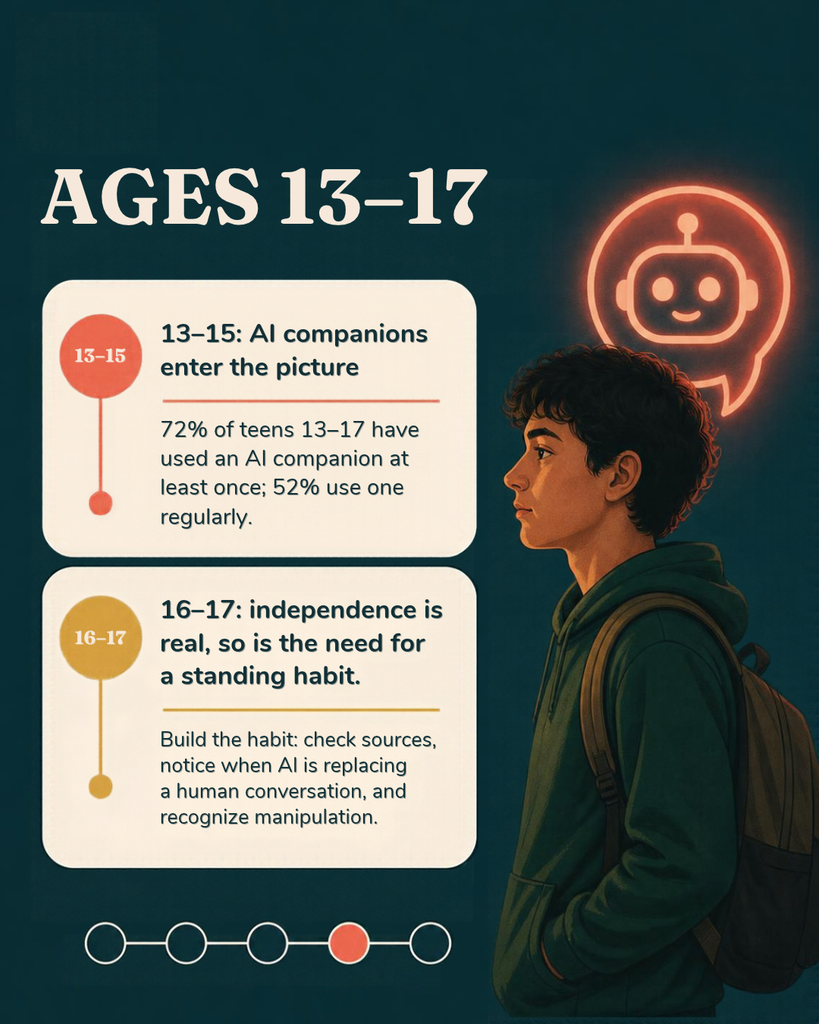
This is the stage where the conversation needs to widen beyond homework, because the data shows kids this age aren’t just using AI as a tool anymore. Common Sense Media’s 2025 national survey found that 72% of teens 13 to 17 have used an AI companion, meaning an app built to feel like a digital friend, at least once, and 52% use one regularly. About a third use companions for social or emotional purposes: roleplay, friendship, romantic interaction, or emotional support. Common Sense Media’s own recommendation, based on this research, is that no one under 18 use AI companions at all.
We think that’s worth taking seriously, and worth a direct conversation rather than a discovery. If your young teen hasn’t brought up AI companions, it’s not necessarily because they aren’t using one. It’s more likely because nobody’s asked.
Ages 16 to 17: Independence Is Real, So Is the Need for a Standing Habit
Older teens are close to adult-level independence with these tools, and by this stage, the goal isn’t supervision so much as it is a habit that’s already internalized: checking sources, knowing when a companion conversation has replaced a conversation they should be having with a person, and recognizing when AI-generated content, including images, is being used to manipulate or harass someone. That last part isn’t hypothetical. We cover it directly in the next section, because it’s arguably the most urgent gap in most families’ AI conversations right now.
What Doesn’t Change By Age
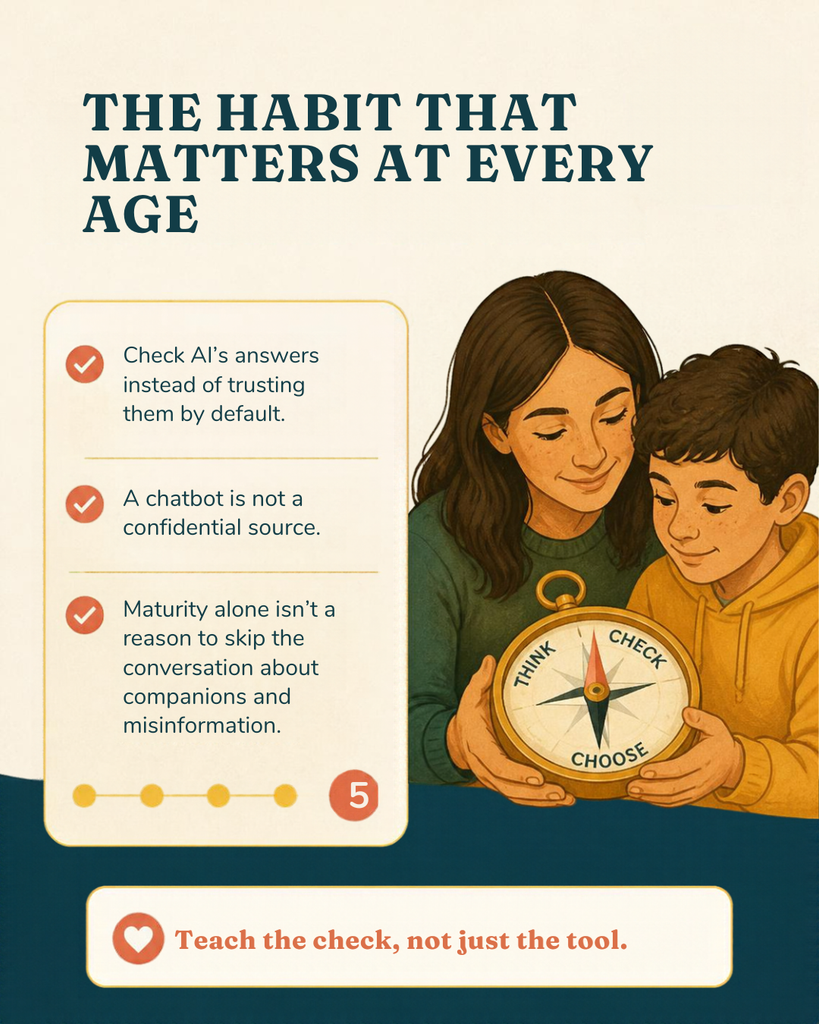
A few things hold at every stage, and they’re worth writing down somewhere you’ll actually see them again:
- The habit of checking AI’s answers matters more than the specific tool being used.
- A chatbot is not a confidential source. Anything shared with one can, in principle, be reviewed, stored, or used to train future models, depending on the platform.
- “My kid seems mature for their age” is true of a lot of kids and isn’t, on its own, a reason to skip the conversation about companions and misinformation. Maturity and exposure to a specific risk are different things.
A Few Questions Parents Ask Us
My kid is 11 and already asking for a chatbot account. Do I say yes?
Most major platforms set 13 as a minimum for a reason tied to data privacy law, not developmental readiness, so the honest answer is usually “not on their own account yet.” A workaround that works for a lot of families: let a younger kid use AI tools through a parent’s account, with you present, rather than either a flat no or an account of their own before the platform allows it.
Is it different if the “AI” is built into something educational, like a reading app?
Somewhat. Purpose-built educational AI tools tend to be narrower and more supervised than a general chatbot, so the risk profile is lower. That said, “educational” isn’t a guarantee of accuracy. The habit of checking still applies, just at a lower intensity for a younger kid.
What if my teenager refuses to talk about this at all?
That reaction is common and usually says more about not wanting to be lectured than about having something serious to hide. Dropping the topic of “companions” specifically and asking a smaller, less loaded question instead, like “what do you use AI for, if anything” often opens the door further than a direct confrontation would.
Related Reading
- AI for Parents: What to Actually Say the First Time Your Kid Asks a Chatbot for Homework Help
- AI for Parents: The Two AI Risks Nobody Warned You About Yet
The Habit Worth Building at Every Age
Whatever age your kid is right now, the skill that holds up across all of them is the same one: teaching them to check AI’s answers instead of trusting them by default. That’s the entire premise behind Don’t Just Trust It: How to Raise a Kid Who Thinks for Themselves in the Age of AI, a parent’s field guide to critical thinking, fact-checking, and spotting when the machine gets it wrong. It’s built to work whether your kid is nine or sixteen; you can explore it at homeandschoolai.com.