

Your ninth grader just asked a chatbot to explain the causes of World War I, pasted three paragraphs into a Google Doc, and called the assignment done. You saw the browser tab still open. Now what?
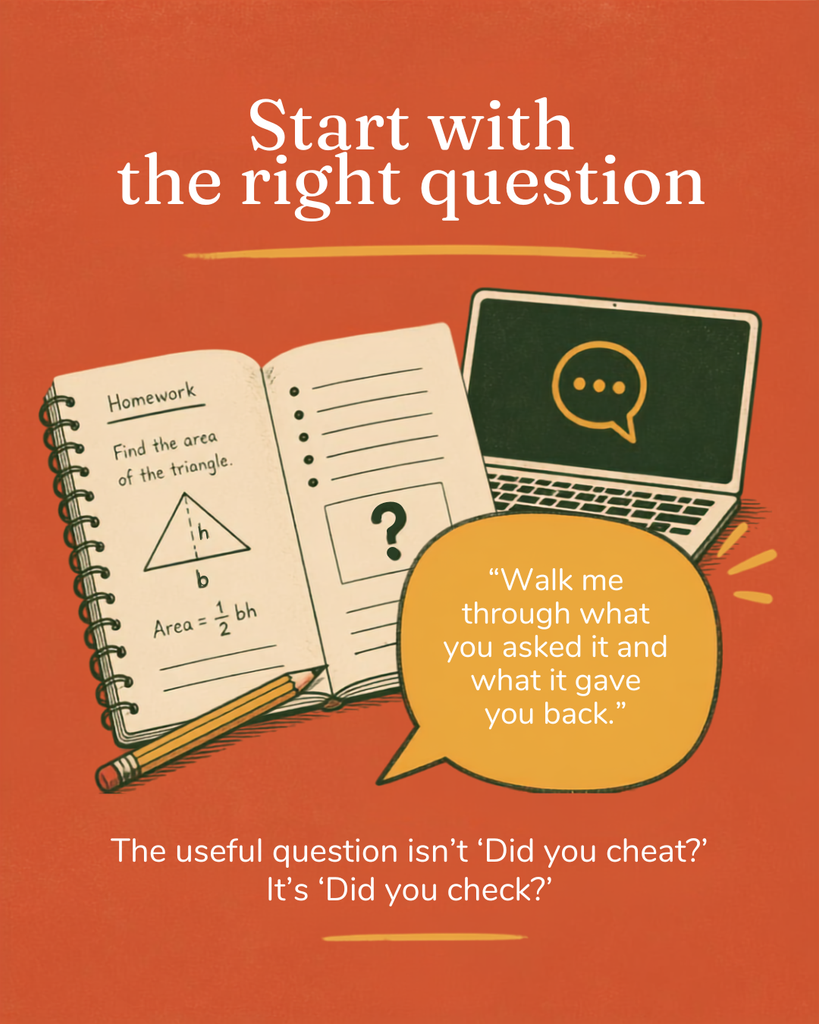
If you’re picturing a lecture about cheating, set it down for a second. That conversation rarely lands, and it’s usually not the one your kid needs anyway. The more useful question isn’t “did you cheat.” It’s “did you check.”
The Numbers Behind the Moment You Just Had
You’re not imagining a trend. The share of U.S. teens who say they’ve used ChatGPT for schoolwork rose to 26% in 2025, double the 13% who said so in 2023, according to Pew Research Center. Older teens use it more: 31% of 11th and 12th graders report using it for schoolwork, compared with 20% of 7th and 8th graders.
Here’s the part that surprised us most reading the data: teens themselves aren’t sure where the line is. Only 54% think it’s acceptable to use ChatGPT for researching a topic. That number drops to 29% for solving math problems, and to 18% for writing essays outright. Most kids already sense that “AI wrote my essay” is different from “AI helped me understand the topic.” They just haven’t been given a clear place to draw that line, and a lot of adults haven’t drawn one for themselves either.
That gap shows up on the parent side too. A recent survey found that 52% of parents and grandparents don’t feel equipped to help kids navigate AI, and only 5% feel genuinely confident doing it, according to the Marketing AI Institute. When parents were asked what they actually wanted to learn, the top answer wasn’t “how AI works.” It was how to spot misinformation and bias in what it produces, and how to help a kid use it responsibly. Which, honestly, is the right instinct. You don’t need to understand a transformer model to have this conversation well.
What’s Actually Happening When a Kid Uses a Chatbot for Homework
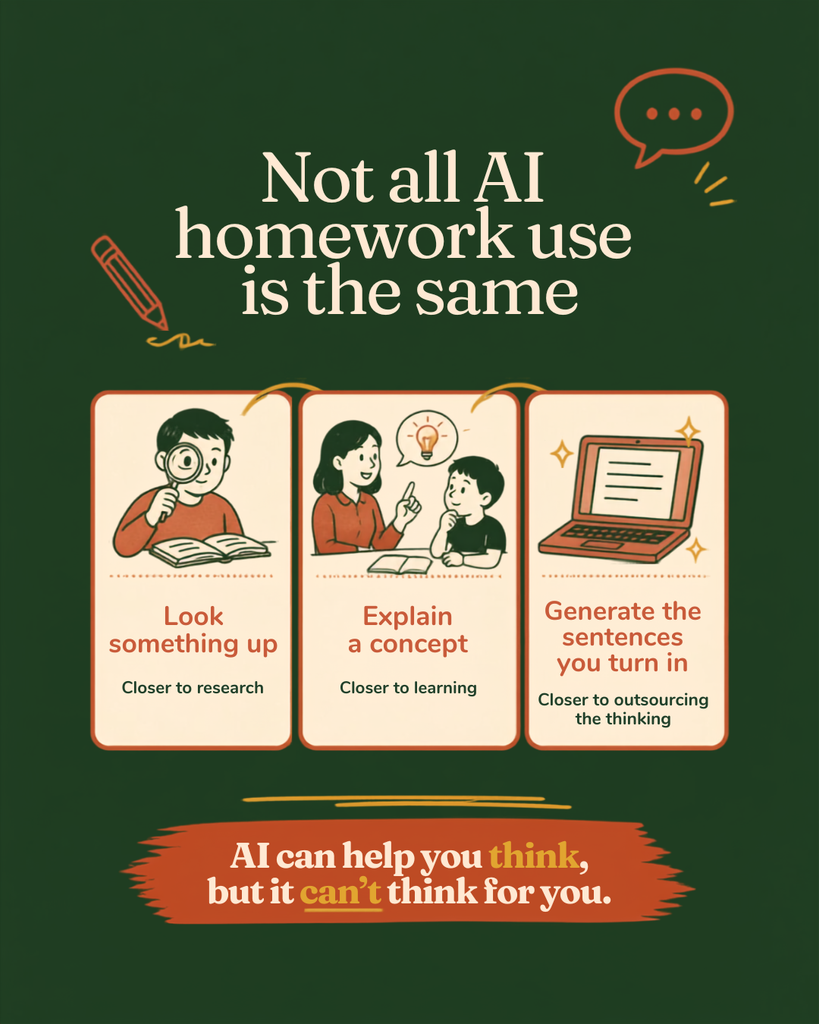
Not all chatbot use is the same problem, and treating it as one flattens something that matters. There’s a real difference between:
- Using AI to look something up, the way an earlier generation used an encyclopedia or a search engine
- Using AI to explain a concept the kid didn’t follow in class
- Using AI to generate the actual sentences that get turned in as the kid’s own writing
The first two are closer to research. The third is closer to outsourcing the thinking the assignment was built to produce. Your job in the conversation isn’t to ban the tool. It’s to help your kid notice which of these three things they’re actually doing, because in the moment, it doesn’t always feel different. A finished paragraph feels like a finished paragraph, whether your kid wrote it or copied it.
Picture two kids doing the same World War I assignment. One asks the chatbot to explain the alliance system, gets confused by the answer, asks a follow-up question in her own words, and then writes her paragraph from what she now understands. The other pastes the assignment prompt directly into the chatbot and submits whatever comes back. From the outside, both papers might read about the same. The difference is entirely in what happened before the paper existed, which is exactly why “did you use AI” is the wrong question to lead with. It can’t tell those two kids apart. “Walk me through what you asked it” can.
The Conversation, Word for Word
Skip the opening about trust and honesty. Start here instead:
You: “Walk me through what you asked it and what it gave you back.”
This does two things. It’s not accusatory, so your kid doesn’t shut down. And it forces them to re-engage with content they may have pasted in without really reading.
You: “Is there anything in there you’d bet money is wrong?”
Most kids have never been asked this. It reframes the chatbot’s answer as something to be tested, not something to be trusted, without you having to deliver a speech about AI hallucinating facts.
You: “If your teacher asked you to explain this out loud right now, could you?”
This is the real test. If the answer is no, the assignment isn’t done yet, whatever’s on the screen. If the answer is yes, something useful actually happened here, and that’s worth saying out loud to your kid.
You: “What would you have written if you’d started from scratch?”
Not as a gotcha. As a genuine question. Sometimes the honest answer is “something worse,” and that’s useful information for both of you about where they need more support, not less AI.
Three Questions Before Anything AI-Touched Gets Submitted
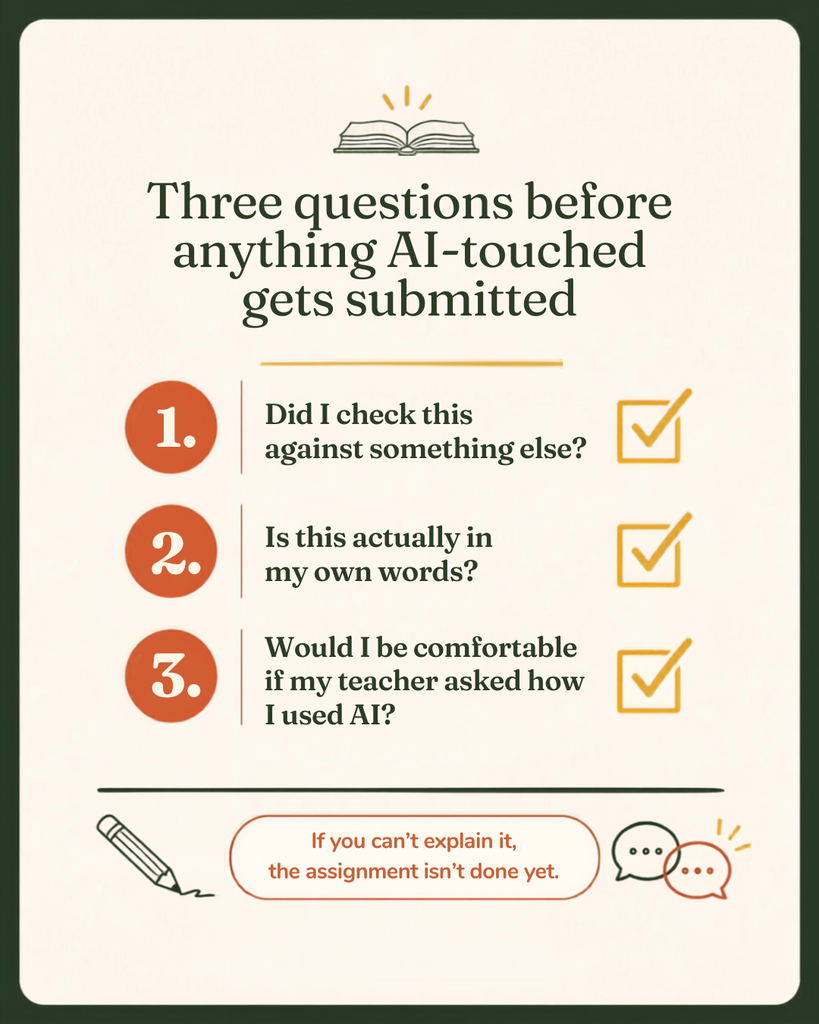
Turn these into a habit, not a one-time lecture:
- Did I check this against something else? One source, especially a chatbot, is not a source. A quick search to confirm a date or a fact takes thirty seconds.
- Is this actually in my own words? Reading a paragraph and understanding it is different from being able to explain it without looking.
- Would I be comfortable if my teacher asked how I used AI on this? If the honest answer makes a kid uneasy, that’s the signal, not a rule you wrote on a whiteboard.
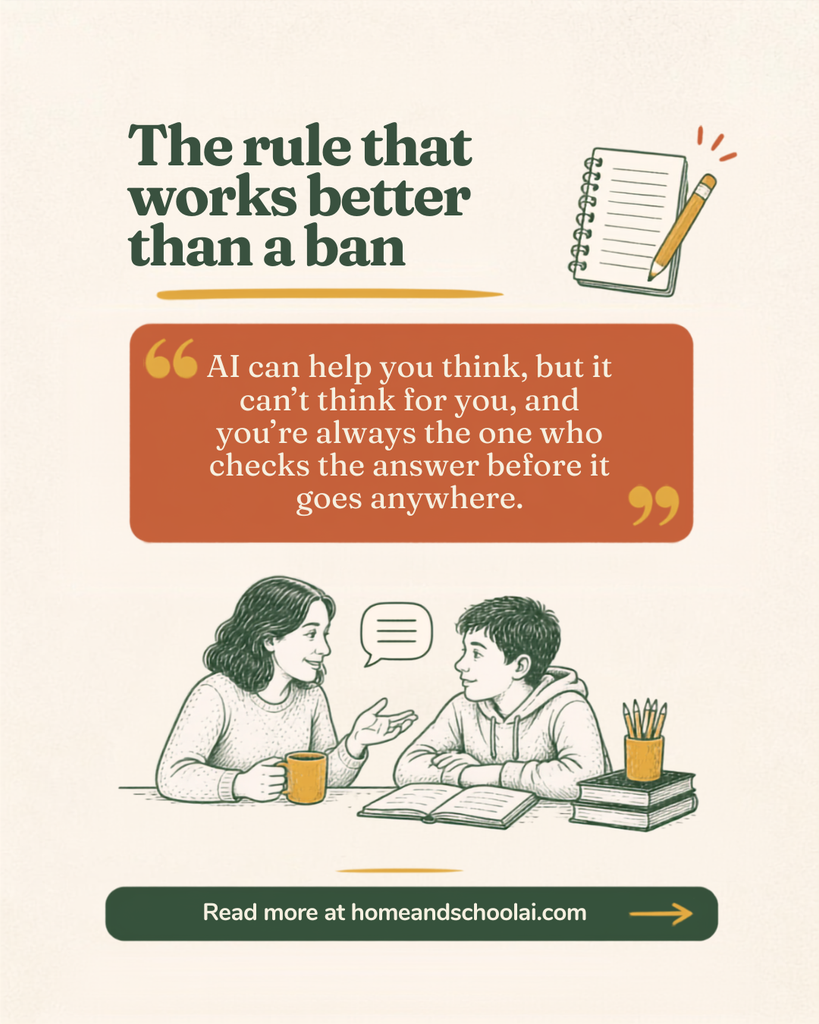
The Rule That Works Better Than a Ban
Outright bans tend to push AI use underground rather than out of the picture; a kid who’s told “never use it” mostly learns not to mention it. A workable house rule sounds less like a ban and more like a habit: AI can help you think, but it can’t think for you, and you’re always the one who checks the answer before it goes anywhere.
That’s a small shift in language, but it changes what you’re actually supervising. You’re not policing whether AI was touched. You’re checking whether your kid can stand behind what got turned in.
When It’s a Bigger Pattern, Not a One-Time Thing
Watch for the difference between curiosity and habit. A kid who occasionally uses a chatbot to unstick a hard problem is doing something most adults do at work now too. A kid who can no longer produce a paragraph without a prompt, who bristles at being asked to explain their own homework, or whose grades on unassisted work are quietly slipping: that’s worth a direct conversation, and possibly a note to the teacher, not another house rule.
It’s worth separating two things that get lumped together: a kid avoiding a hard assignment, and a kid who’s lost confidence that they can do it without help. The first responds to a clearer rule. The second usually needs you to sit next to them for one assignment and prove, gently, that they still can. Punishing the second kid like the first one tends to make the avoidance worse, not better.
A Few Questions Parents Ask Us
Should I just block chatbots on my kid’s devices? For younger kids, device-level limits can buy you time to have the bigger conversation first. For a teenager, a block usually just moves the activity to a friend’s phone or a school computer, out of your sight entirely. A clear household expectation, paired with occasional spot-checks, tends to hold up better than a technical wall for this age group.
What if the teacher’s own policy on AI isn’t clear? Ask directly, in an email or at conferences: “What’s your policy on AI use for assignments in this class?” Plenty of teachers are still working this out themselves, and a specific question gets a more useful answer than assuming either that anything goes or that everything’s banned.
My kid says “everyone uses it,” is that true? Somewhat. Pew’s data puts actual use at about a quarter of teens nationally, so “everyone” is an overstatement, though it’s climbing fast and it’s certainly true within some friend groups. Either way, it’s not a great argument for or against a household rule on its own. What matters more is whether your kid can explain what they did and stand behind it.
If Tonight’s Conversation Went Well
The habit you just started, teaching a kid to check AI’s work instead of trusting it outright, is the whole idea behind Don’t Just Trust It: How to Raise a Kid Who Thinks for Themselves in the Age of AI, a parent’s field guide to critical thinking, fact-checking, and spotting when the machine gets it wrong. If tonight opened the door, that guide is the natural next step; you can explore it at homeandschoolai.com.
Related Reading
- AI for Kids: What Age Is Actually Old Enough for a Chatbot (And What Changes at Each Stage)
- Parenting with AI: The Household Rules That Actually Stick
Sources
- Pew Research Center, “About a quarter of U.S. teens have used ChatGPT for schoolwork,” January 2025: https://www.pewresearch.org/short-reads/2025/01/15/about-a-quarter-of-us-teens-have-used-chatgpt-for-schoolwork-double-the-share-in-2023/
- Marketing AI Institute, “The Parent AI Education Gap”: https://www.marketingaiinstitute.com/blog/parent-ai-education-gaps