

If your teenager asks whether it’s okay to use AI on their college essay, the honest answer is: it’s complicated, and most colleges haven’t actually told you where the line is.
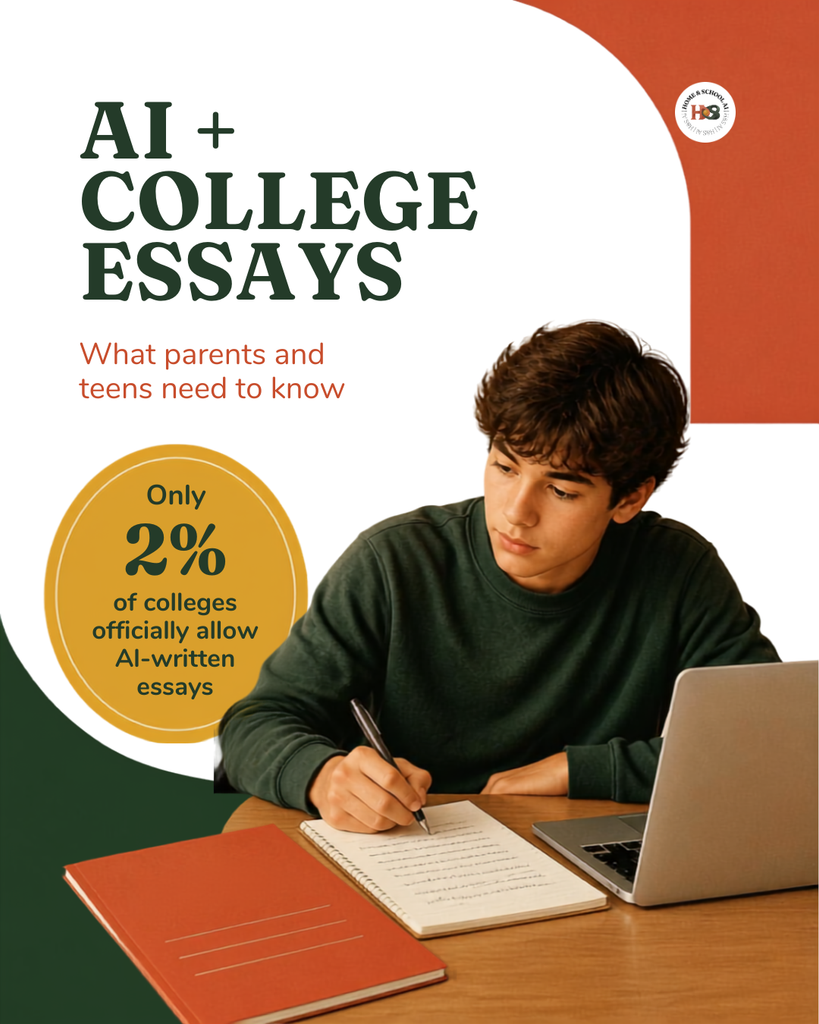
A November 2025 survey of more than 200 college admissions officers by Kaplan found that only 2% of colleges have an official policy explicitly allowing AI to write an applicant’s admissions essay, while 30% officially ban it. The rest, a full 68%, have no policy at all. Your family is, in a very literal sense, navigating a gray area that most institutions haven’t bothered to define.
This isn’t a small or shrinking niche of the application process, either. AI use during the broader college search has climbed fast: from 4% of seniors using tools like ChatGPT to explore colleges in 2023, to 10% in 2024, to 23% in 2025, according to Carnegie’s Summer Research Series survey. The essay is the one piece of that process where the rules, and the stakes, are noticeably different from the rest.
What Admissions Officers Actually Said They Care About
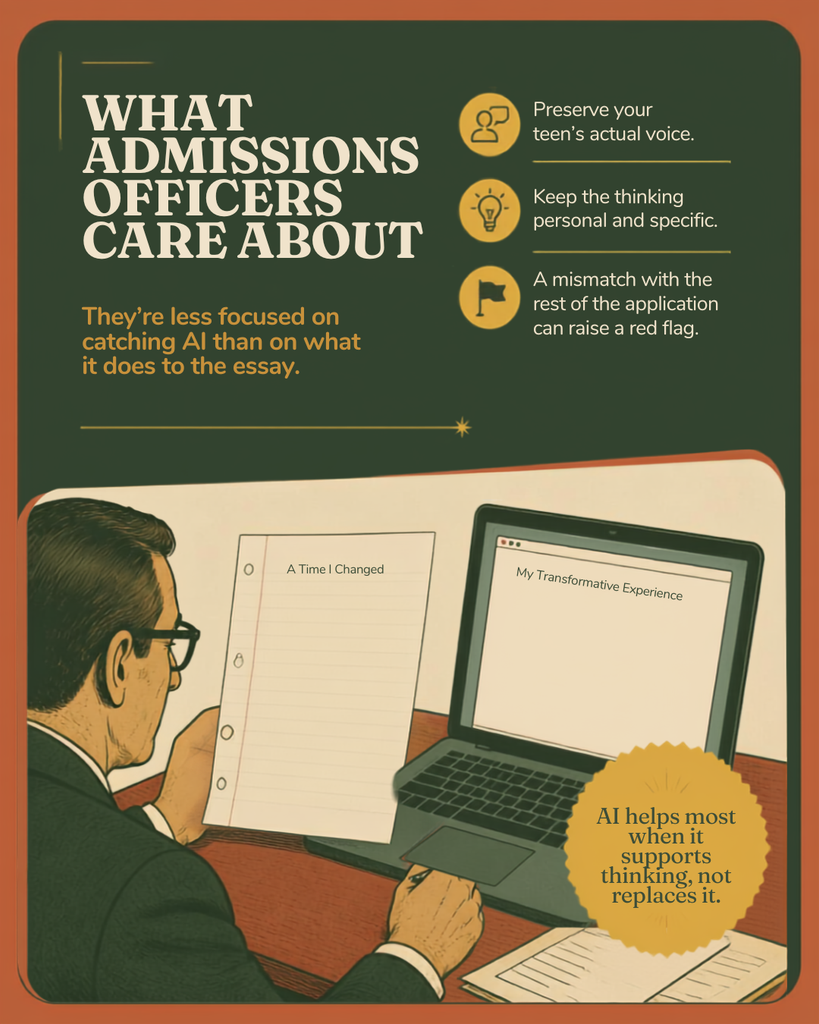
Here’s the more useful part of the same survey: officers weren’t primarily worried about AI use as a rules violation. They were worried about what it does to the essay itself. AI-generated writing, several officers said, tends to strip an essay of its personal voice, producing something generic that doesn’t reflect a student’s actual experiences or way of thinking. One officer specifically noted that AI-assisted writing often doesn’t match the tone of the rest of a student’s application, which, in practice, is its own kind of red flag, whether or not a school has a formal detection policy.
That’s a genuinely useful signal, more useful than a blanket rule would be. It tells you what the essay needs to preserve, your teen’s actual voice and actual thinking, regardless of what tools touched it along the way.
Where AI Genuinely Helps
Brainstorming. Twenty-seven percent of admissions officers say their school has an official policy allowing AI for brainstorming essay ideas, more than four times the share that allow AI-written text outright. Using a chatbot to generate ten possible essay angles, then picking the one that’s actually true and interesting, is a fundamentally different activity than asking it to write the essay.
Getting unstuck. A blank page is often the hardest part of an application essay. Asking AI a few clarifying questions, “what makes this story interesting,” “what should I focus on here,” can move a stuck student forward without putting a single one of the AI’s sentences into the final draft.
Line-level feedback on a draft the student wrote. Twenty-one percent of officers say their school allows AI to give feedback on independently drafted essays. This is closer to what a good writing tutor does: pointing out a weak paragraph or an unclear sentence, not generating replacement text.
Where It Actively Hurts
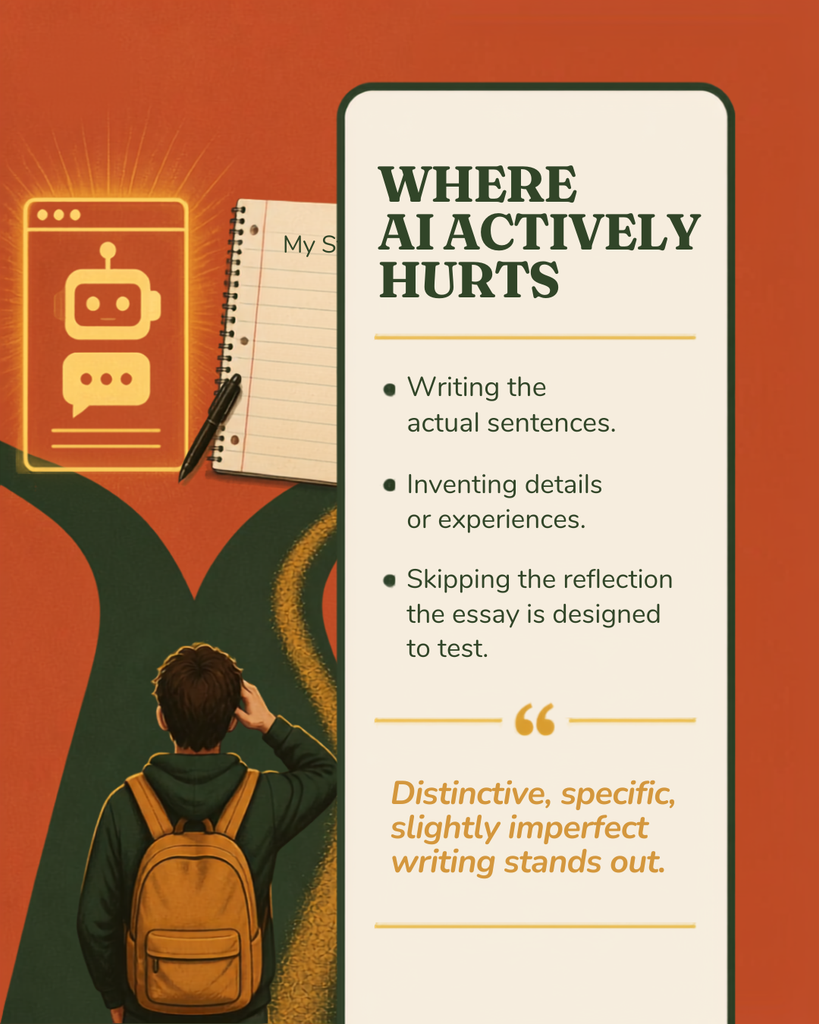
Anything that becomes the actual sentences. This is the use case admissions officers flagged most directly, and it’s the one most likely to be officially banned outright, at 30% of schools and rising. Beyond the rules question, it’s also, per officers’ own comments, the version most likely to read as generic and get noticed for exactly that reason.
Using AI to invent details or experiences. A chatbot doesn’t know your teen’s actual life. Prompting it to “make this sound more impressive” tends to produce embellishment that a careful reader, and an experienced admissions officer reads thousands of these, can often sense even without formal detection software.
Skipping the reflection the essay is designed to test. A college essay isn’t really testing writing ability in isolation. It’s testing whether a student can reflect on their own experience and communicate something true about it. That’s the one part of the process AI genuinely cannot do on a student’s behalf, no matter how good the prose comes out.
Optimizing for what sounds impressive instead of what’s true. There’s a specific failure mode worth naming: a student asks AI to make an essay “sound more like a successful applicant,” and the tool, having no access to actual admissions data, produces something that sounds vaguely like every other AI-polished essay it’s seen, ambitious, articulate, a little hollow. Officers read thousands of these a season. Distinctive, specific, slightly imperfect writing tends to stand out precisely because it doesn’t sound optimized.
A Reasonable Family Rule
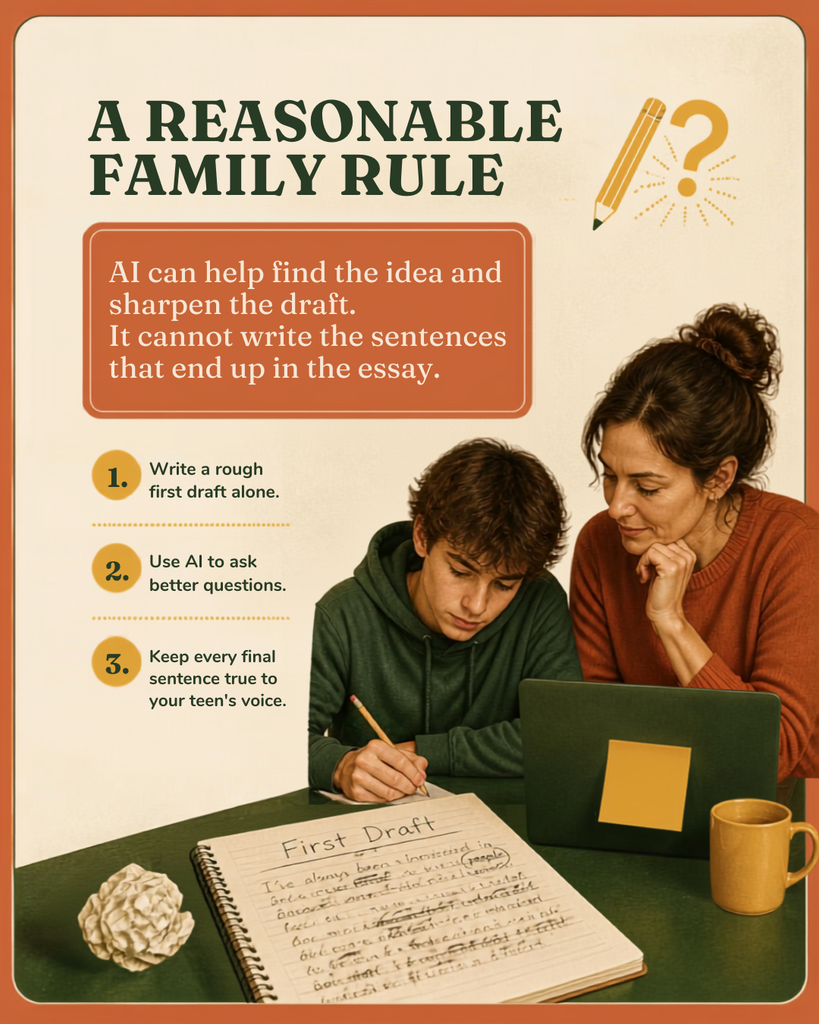
Given the gray area officers themselves describe, here’s a rule that tracks with what the survey data actually supports: AI can help find the idea and sharpen the draft. It cannot write the sentences that end up in the essay. If your teen can’t point to which parts came from their own head versus a chatbot’s, that’s the sign the process has drifted too far.
Encourage your teen to write a rough, messy first draft entirely on their own before any AI tool touches the essay at all, even for brainstorming. The messy draft is where the actual voice lives. AI can help shape it afterward. It’s much harder to find a genuine voice if it starts by generating something polished and then tries to work backward toward “sounding like them.”
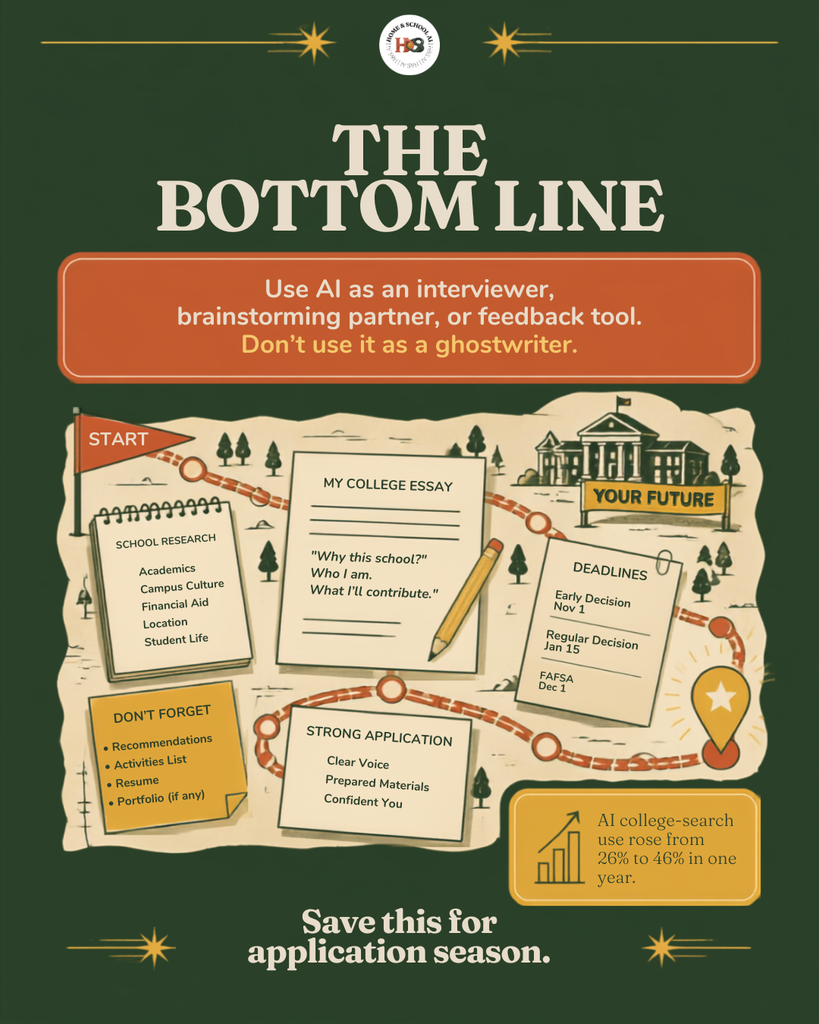
If your teen genuinely doesn’t know where to start, a low-risk way to use AI at the very front of the process is to ask it questions about themselves rather than about the essay: “what are three moments in my life that changed how I think about something,” described in your teen’s own words to the chatbot first. The AI’s job there is to ask better questions, not supply better answers. That distinction, AI as an interviewer versus AI as a ghostwriter, tends to track closely with what officers said they’re actually looking for.
Beyond the Essay: The Rest of the Application
AI use during college search itself has grown fast and mostly uncontroversially. Nearly half of high school students, 46%, now use AI tools during their college search process, according to a 2026 survey from EAB, up from just 26% the prior spring, mostly for researching schools, comparing programs, and organizing deadlines. That kind of use carries little of the risk the essay does. Nobody is evaluating your teen’s authentic voice in how they researched financial aid deadlines.
A Few Questions Parents Ask Us
Is it worth checking with each specific school about their AI policy?
Given that 68% of schools have none at all, checking is more likely to turn up silence than a clear answer. Where you can find one, though, it’s worth doing, particularly for schools your teen is most invested in. Absent a clear policy, treat the “voice and reflection” standard above as the safer default.
Will admissions officers really be able to tell if AI wrote the essay?
Detection software is unreliable in both directions, and we wouldn’t build a strategy around evading or relying on it either way. What officers describe noticing isn’t a software flag; it’s a mismatch between an essay’s tone and the rest of the application, something a careful, experienced reader picks up on directly.
What about using AI for the rest of the application, like the activities list or short-answer questions?
The same voice-and-reflection principle applies, though the stakes are generally lower for shorter, more factual sections. The full essay is where admissions officers say the authenticity question matters most, so that’s where the most caution is worth applying.
Related Reading
- AI for Parents: What to Actually Say the First Time Your Kid Asks a Chatbot for Homework Help
- AI for Kids: Is It Making Them Better Thinkers, or Worse Ones?
The Skill Underneath This Whole Question
Knowing the difference between AI that sharpens a student’s actual thinking and AI that quietly replaces it is exactly the skill covered in Don’t Just Trust It: How to Raise a Kid Who Thinks for Themselves in the Age of AI, a parent’s field guide to critical thinking, fact-checking, and spotting when the machine gets it wrong. It applies well beyond homework, including the essay that may matter more than any single assignment your teen writes in high school. You can explore it at homeandschoolai.com.
Sources
- Kaplan, “College Admissions Officers Survey 2025: Essays & AI,” November 2025: https://kaplan.com/about/press-media/college-admissions-officers-survey-2025-essays-ai
- EAB, “Nearly Half of High School Students Now Use AI in College Search,” February 2026: https://eab.com/?p=237694